

How to Calculate Lateral Spacing and Sprinkler Spacing in Latched Sprinkler Pipe Systems
Lateral spacing and sprinkler spacing are calculated as a percentage of the sprinkler's wetted diameter. In a square pattern, the maximum is 55% of the diameter in calm air, 50% in moderate wind and 45% in strong wind. You then check that the application rate (mm/h) stays below the soil's intake rate.
Correct spacing lets latched sprinkler pipes deliver an even depth of water across the field, in Spain, Morocco or Türkiye.
|
Quick Summary
|
What Are Lateral Spacing and Sprinkler Spacing?
A sprinkler does not spread water evenly. Depth is highest near the sprinkler and drops toward the edge of the wetted circle. That is why NC State Extension notes that spacing between sprinklers and laterals is normally 50–65% of the manufacturer's wetted diameter.
Overlap lets each sprinkler fill the weak outer ring of its neighbour.
-
Wetted diameter: the value in the sprinkler catalogue for a given pressure and nozzle size.
How Do You Calculate Sprinkler Spacing Step by Step?
-
Take the wetted diameter at operating pressure from the sprinkler catalogue.
-
Pick the wind-based percentage for your pattern from the table below.
-
Multiply the wetted diameter by that percentage: this is the maximum spacing.
-
Round down to a value that fits your latched sprinkler pipe lengths.
-
Calculate the application rate and compare it with the soil intake rate.
Maximum Spacing by Wind Speed
|
Wind speed |
Square pattern (% of diameter) |
Triangular pattern (% of diameter) |
|
0–5 km/h |
55% |
60% |
|
6–11 km/h |
50% |
55% |
|
13–19 km/h |
45% |
50% |
Source: Lawn & Landscape – Proper Sprinkler Spacing; values converted from mph to km/h.
Use local wind data: AEMET in Spain, Maroc Météo in Morocco.
Worked Example: Sprinkler With a 30 m Wetted Diameter
-
Wetted diameter: 30 m (catalogue value, example).
-
Wind: 6–11 km/h, square pattern → 50%.
-
Maximum spacing: 30 × 0.50 = 15 m → layout 15 m × 15 m.
-
Sprinkler flow: 1,500 L/h (example).
-
Application rate: 1,500 ÷ (15 × 15) = 6.7 mm/h.
This suits loam (10–20 mm/h); on clay (1–5 mm/h) it causes runoff, so use a smaller nozzle.
What Happens if a Sprinkler Irrigation System Exceeds Soil Intake?
Netafim's sprinkler selection guide gives the formula: sprinkler flow (L/h) ÷ (spacing between sprinklers × spacing between rows). The result is in mm/h.
If the soil cannot absorb it, water ponds and runs downslope. FAO lists these basic infiltration rates:
|
Soil type |
Basic infiltration rate (mm/h) |
|
Sandy loam |
20–30 |
|
Loam |
10–20 |
|
Clay loam |
5–10 |
|
Clay |
1–5 |
Square vs Triangular Pattern: Which Is Better?
Square Pattern
Pros and Cons
-
Pro: a latched lateral is easy to reset at the same spacing after every move.
-
Pro: edge and corner planning is simple in rectangular fields.
-
Con: it needs closer spacing than a triangle in the same wind, so it may use more sprinklers.
Triangular Pattern
Pros and Cons
-
Pro: the table allows 5 points wider spacing in the same wind.
-
Con: sprinklers on neighbouring laterals must be offset by half a spacing.
How Do Latched Sprinkler Pipes Affect Lateral Design?
Wetted diameter depends on operating pressure: if pressure drops along the lateral, coverage shrinks. Pipe pressure class is part of the spacing calculation.
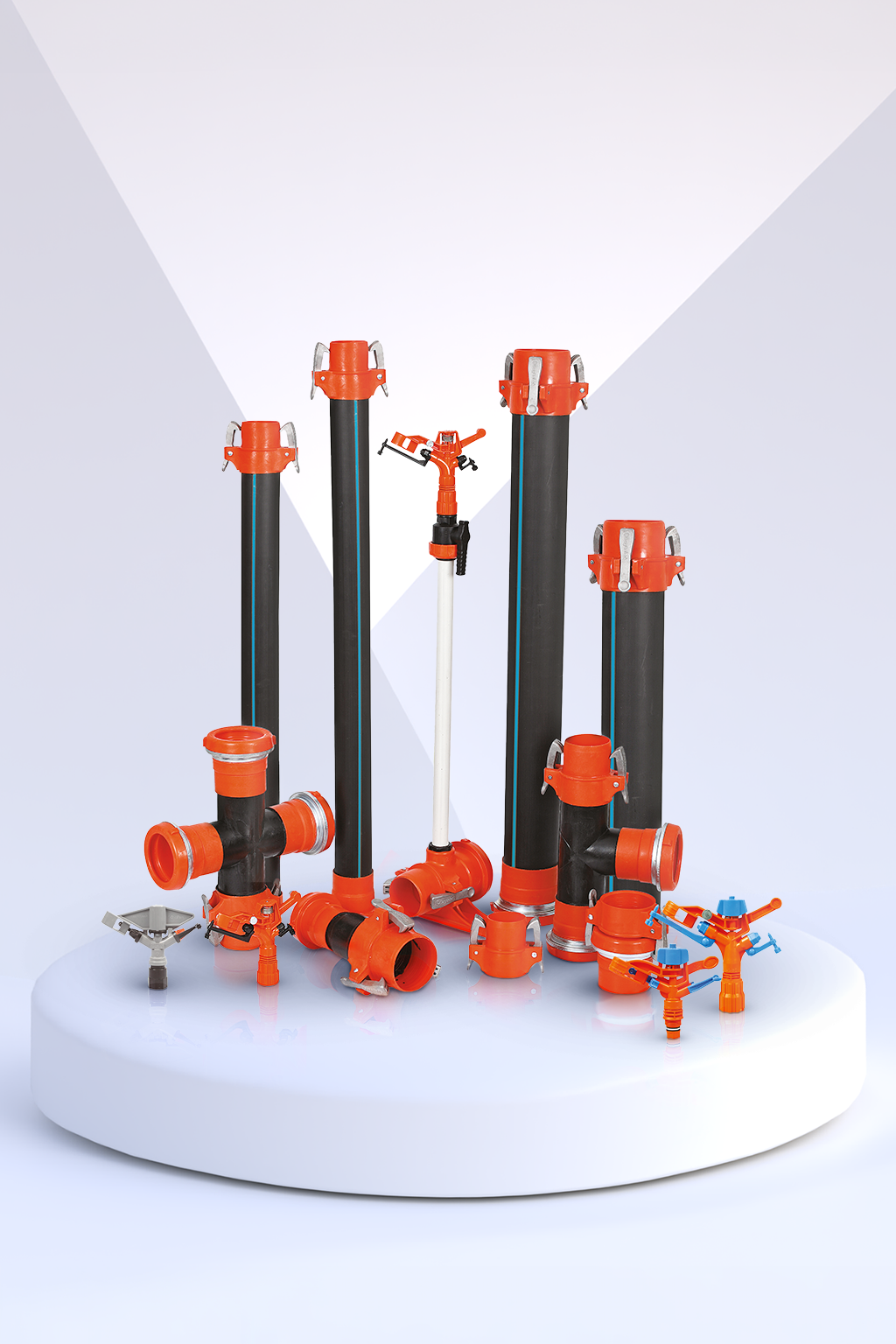
Düzgünler Plastik latched sprinkler pipes are made from high-density polyethylene to TS EN 12201-3. The latch lock gives a leak-proof joint; the UV-resistant body suits open fields in Spain and Morocco. Planning spacing as a multiple of pipe length speeds up every move.
Which Atu Rating of Latched Sprinkler Pipes Should You Choose?
Add friction loss and elevation difference to the sprinkler operating pressure, then choose the class above that total:
|
Product |
Pressure class |
When to choose |
|
5 Atu Latched Sprinkler Pipes |
5 Atu |
Total line pressure stays below 5 Atu |
|
6 Atu Latched Sprinkler Pipes |
6 Atu |
Total pressure is 5–6 Atu |
|
8 Atu Latched Sprinkler Pipes |
8 Atu |
Long laterals or slopes with 6–8 Atu total |
|
10 Atu Latched Sprinkler Pipes |
10 Atu |
High-pressure sprinklers or large elevation gain, 8–10 Atu |
Note: 1 Atu is roughly 1 bar. Always confirm against the sprinkler catalogue's operating pressure.
New vs Second-Hand Agricultural Irrigation Pipe: Which Is Safer?
Second-hand agricultural irrigation pipe looks cheaper, but the spacing calculation assumes the line holds its design pressure.
-
New pipe: known pressure class and standard; latches and seals are unworn.
-
New pipe: the spacing you calculated works at the same pressure in the field.
-
Second-hand pipe: UV ageing and latch wear may not be visible.
-
Second-hand pipe: leaking joints lower pressure, shrink coverage and leave dry strips.
How Does the Water Source Fit Into a Sprinkler Irrigation System?
Total flow of sprinklers running at once must not exceed the well's continuous yield. If 20 sprinklers at 1,500 L/h run together, the sprinkler irrigation system needs 30 m³/h.
The fixed main line and well pipes are sized from the same figure. Düzgünler Plastik also produces U-PVC deep well pipes and 4–16 Atm U-PVC pressure water pipes for this purpose.
|
Planning a sprinkler irrigation system in Spain or Morocco? Explore our Latched Sprinkler Pipes category or request a quote with your field size and sprinkler data. |
Frequently Asked Questions - FAQ
How far apart should sprinklers be?
In a square pattern, 45–55% of the wetted diameter. For a 30 m diameter sprinkler that is 13.5–16.5 m, depending on wind.
What does head-to-head coverage mean?
Spacing equals the throw radius, so each sprinkler's water reaches the next one.
Can you irrigate with sprinklers in windy weather?
Yes, with tighter spacing. University of Missouri Extension advises irrigating when wind is under 5 mph (about 8 km/h) where possible.
How do you calculate sprinkler application rate?
Sprinkler flow (L/h) ÷ (sprinkler spacing × lateral spacing) = mm/h.
Which pressure class should a latched sprinkler pipe have?
Choose the 5, 6, 8 or 10 Atu latched sprinkler pipe above operating pressure plus friction loss and elevation difference.
People Also Ask - PAA
How many sprinklers do I need per hectare?
One hectare is 10,000 m². At 15 × 15 m each sprinkler covers 225 m², about 44 sprinklers per hectare, excluding edges.
Is a triangular pattern always more efficient?
No. A square pattern is easier to reset with portable latched laterals.
Can I measure wetted diameter myself?
Yes. Run one sprinkler at working height and pressure and measure the throw.
|
Author: Düzgünler Plastik Technical Team Prepared by the Düzgünler Plastik irrigation team (Konya, Türkiye, founded 1975) using the sources below. |
Sources
For more information about our products and production processes, please contact us.
For more content, please visit our blog.
Similar Blogs